

For YEARS I thought I was just a “bad mom.” No matter how hard I tried (new routines, better planners, simpler schedules), everything eventually collapsed back into chaos. Until one day I sat down, opened an empty spreadsheet, and started writing down everything I was actually doing. The data told a story I wasn’t prepared for. It turns out, I wasn’t failing at motherhood. I was trying to survive THE IMPOSSIBLE.
Many moms quietly live inside a cycle of exhaustion they struggle to explain. That constant feeling that they are failing at something that should feel “natural.”
My own transformation started with a quite simple and innocent moment: a question from my partner that forced me to confront something I had been avoiding. And that day, when I finally started documenting everything I was carrying (kids schedules, emotional labor, planning, and overall the never-ending daily logistics of raising FOUR children, I realized the problem wasn’t my discipline or organization.
The problem was the system itself.
In this first piece of the Invisible Mothers series, I explore why modern motherhood feels impossible, why so many women hide their exhaustion behind the phrase “I’m just tired,” and what changes when we finally stop pretending everything is manageable.
TABLE OF CONTENTS
- The Breaking Point – The moment a simple question forced me to confront the exhaustion I couldn’t explain.
- The Performance of “Easy” (Why do moms hide their struggle and treat their exhaustion like a personal failure)
- The Architecture of the Impossible – How becoming a mom rewires your brain and why modern parenting fights against our own biology.
- Dropping the Mask – What happens when we stop pretending everything is manageable.
- The Invitation to Radical Honesty – A simple question that might change how you see your own exhaustion.
1. THE BREAKING POINT
It’s almost comical, how everyone keeps pretending. As if the tidy hair and fancy clothes could somehow erase the remains of yesterday’s dinner from under our fingernails.
The moment everything cracked actually wasn’t dramatic at all. No screaming kids. No catastrophic event. Just a simple, casual question from my partner that landed like a physical weight on my shoulders: “Have you burned out again? From motherhood?”
That question followed one of my never-ending get-it-done-right cycles: an honest attempt to build order in a home with four kids (and a cat, a dog, and a pigeon), followed by the inevitable collapse when nothing stuck. For a few days (sometimes weeks on a good run), it my new “parenting hack” would work. Then quietly, the chaos would creep back in. Been there?
Routines dissolved, laundry has magically multiplied. And I’d end up in the same place I’d been so many times before: standing in the kitchen, overwhelmed and crying, feeling like I had failed at the only things that mattered. Being a good mom and a good partner. Somehow it felt that the house (and life) was running me, not the other way around.
I thought I had already solved the internal problem. I’d been to therapy. Dismantled the belief that I was only worthy when productive. I stopped calling myself lazy. I had uncovered the childhood patterns that drove me to over-perform and stopped pushing myself to the edge. And yet nothing actually improved. The chaos was still there. And underneath all of it was one relentless thought: “Why the f*ck is nothing getting better? Why does everything fall apart the moment I stop holding it together?”
Yet one day something shifted. That day, I didn’t ask my kids for the hundredth time to tidy their rooms. I didn’t cry, or shout, or explain myself. I JUST STOPPED.
Not because the chaos was gone. But because I realized I had no clear picture of what I was actually carrying. And neither did anyone else. So instead of trying to fix the house (or my family) again, I decided to DOCUMENT what i was actually carrying.
I opened a spreadsheet on my laptop and started writing, almost notoriously (all the while thinking about what i should be doing instead). It took me close to 5 hours to just write it all down:
- doctors’ appointments
- emotional meltdowns
- school requests
- groceries, cooking, meal planning
- household chores
- anticipating problems before they happened
- fixing them when they did
All while trying to reparent myself, contemplating starting a new career after being a stay-at-home mom for twelve years, working through my old patterns, and trying to stay sane.
At first, I thought I was doing this to prove a point. To show my partner (and my kids, eventually) exactly how much I contributed. But then I saw it. An entire invisible system of labor that had been living only in my head. My brain had been whispering, “You didn’t do anything today,” while I was staring at a list of work that could run a small corporation. But how the hell did I get here?
—
We say “I’m just tired” because, honestly, the truth is a little heavier than that. “I am spiritually and physically depleted to the point of erasure” is not a sentence you drop in a grocery store aisle. Because, saying you’re tired doesn’t make anyone uncomfortable. Nobody has to stop what they’re doing to respond to it. And besides – you don’t want to complain, right?
The thing is, I couldn’t articulate how I felt (and what was going on in my head) even for myself. That I felt stretched so thin that parts of me were starting to disappear. That my brain was constantly scanning for the next thing that would fall apart. That my body felt like it had been running a marathon with no finish line.
So we say tired.
Somewhere between that 5 hour long spreadsheet and that familiar sentence, I realized something that changed how I saw everything.
I wasn’t failing at a manageable task. I was trying to survive an impossible one.
Because many of us are participating in something I love to call a quiet collective delusion: that if we could just wake up earlier, try harder, organize better, buy the right planner, the chaos would finally resolve itself. As if the problem were too little effort. As if the system itself wasn’t fundamentally unsustainable.
That’s when I realized that no amount of better planning makes the impossible manageable. That realization was the beginning of something I hadn’t felt in a long time.
Not shame. Not guilt.
JUST CLARITY.
2. THE PERFORMANCE OF “EASY” (The Paradox)
Moms? Why do we hide? Why do we treat our exhaustion like a moral failure?
Only months later I realized that the same clarity I found in that spreadsheet is a direct threat to the performance we’ve all been taught to put on.
So eventually I had to ask myself: Why do so many mothers treat their exhaustion like a personal failure instead of what it actually is? A signal that something about the system isn’t working?
Part of the answer lies in the script we’ve all inherited. We’re told that mothering is “natural.” And somewhere along the way, natural quietly became a code-word for effortless. As if love should automatically make everything manageable. As if instinct alone should organize a household, regulate your children’s emotions, remember every appointment, anticipate every need, and still leave room for patience, presence, and a functioning adult life.
When motherhood doesn’t feel effortless, the explanation seems obvious: “I must be the problem. Maybe I’m not organized enough. Not disciplined enough. Maybe other mothers just handle it better.”
So we try harder. At least that’s exactly what I did.
I looked for better systems. Better routines. Better planners. Better ways to optimize the chaos. But underneath all that effort sat something much quieter and heavier.
Shame.
Because when something that’s supposed to be “natural” feels overwhelming, the immediate assumption is that something must be wrong with us. We scroll past curated Pinterest snapshots of other families – smiling kids, clean kitchens, color-coded calendars, and our brains do a very human thing. They compare. The story we tell ourselves then becomes painfully simple:
“If it looks easy for her but feels impossible for me, I must be broken.”
Unsurprisingly, guilt enters the conversation right after. Because motherhood carries another silent rule: if you admit it’s hard, it must mean you don’t appreciate it enough. Or even worse, that you don’t love your children enough. So we hide the struggle. We perform. We minimize the exhaustion (and say we’re just tired). And the next day? We look yet for another hack or system or solution.
What makes me angry the most is there’s yet another layer that rarely gets discussed: the system that actually depends on mothers continuing this performance.

Because, let’s be honest, if mothers collectively stopped pretending everything was manageable, the cracks would become impossible to ignore. Workplaces might have to rethink their expectations. Communities might have to rebuild the support networks they slowly dismantled over the past decades. And caregiving might finally have to be recognized as real labor instead of something that magically happens in the background.
It’s much easier for the world if mothers keep saying they’re fine, isn’t it?
So the performance continues. Quietly (and often completely alone).
What I found out eventually on my own skin, is that this performance isn’t just exhausting. It is expensive. While the culture tells us to just keep swimming, our nervous systems are sounding an alarm we’ve been trained to ignore.
To understand why trying harder never felt like enough, I started looking at what modern life is actually doing to the mom’s (maternal) brain.
PART 3 – THE ARCHITECTURE OF THE IMPOSSIBLE
You are expected to work like you don’t have children and parent like you don’t have a job, all while navigating a world that has erased the “village”, while simultaneously increasing its expectations of your parenting “output.”
The simple truth is motherhood doesn’t just change your schedule. It changes your brain.
Have you heard of the term matrescence? It’s the transition into motherhood, a developmental shift comparable in scale to puberty. Your brain undergoes a massive neurological remodel to make you more attuned to your child’s needs.
From a survival perspective, this is actually brilliant. Your brain becomes highly calibrated to social cues, safety signals, and emotional shifts in your children. You notice the quiet mood change before the meltdown. You sense when something’s off. It’s a kind of caregiving radar. But in our modern world, that radar rarely gets to switch off. Why?
Your brain isn’t just tracking one child. It’s simultaneously tracking multiple schedules, emotional states, and logistical threads:
- Does the toddler have clean socks?
- Did the school need that permission slip today?
- Why was the oldest so quiet at dinner?
- Did I RSVP to that birthday party?
- When did the baby last drink water?
The list is endless.
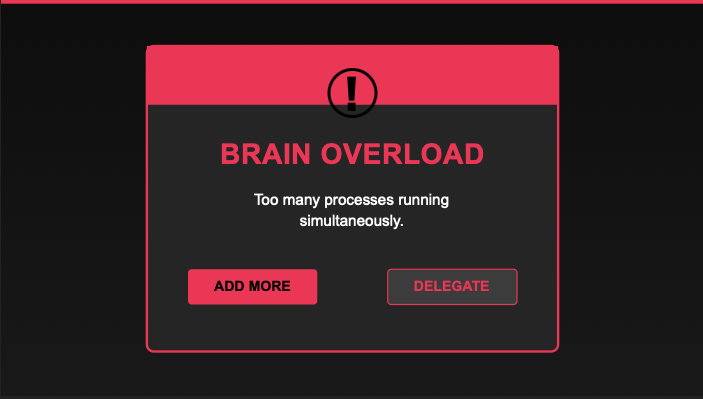
At any given moment, there are dozens of these micro-decisions running in the background of your brain. We joke about “mom brain” (I personally hate that term), but what most mothers are experiencing is in plain and simple terms just a cognitive overload.
Think of your mind as a browser with too many tabs open. Every child, appointment, meal, and emotional dynamic is another tab. And when too many tabs are running all at once, the whole system slows down. Not because anything is broken, but because it’s running too much at once.
There’s another layer that makes modern parenting uniquely exhausting: we did not evolve to raise children alone.
Anthropologists describe humans as cooperative breeders. Historically, children were raised within extended networks – grandparents, siblings, neighbors, community members. The cognitive and emotional load was shared. Today, many families are raising children in relative isolation, while expectations around parenting have dramatically increased. The village is gone. The job description got longer.
So if you feel like you’re running in constant survival mode – it’s not because you’re weak. It’s because you’re trying to be the entire village yourself.
PART 4 – DROPPING THE MASK (What happens when you stop pretending. The relief + the anger)
There is a specific kind of liberation that happens when someone finally says, “This isn’t hard because I’m failing; it’s hard because it’s actually impossible.”
When you start to understand that the problem isn’t your discipline, your time management, or your capacity to “handle it”, the whole performance starts to feel strange. In my case, it felt almost infuriating.
Because suddenly the question shifts. It’s no longer “Why am I failing at this?” It becomes: “Why am I pretending this is manageable?”
That realization doesn’t arrive softly. It arrives with several emotions at once: anger, grief and finally, relief.
The anger and grief come first.
When I stopped pretending everything was fine, stopped accepting that being overwhelmed and under-supported was just normal, I finally had to admit how exhausted and furious I actually was. How angry I was about carrying so much alone. How long I’d been running on empty while telling everyone, including myself, that it was “just a busy phase.”
It took me years to learn the difference between being in victim mode and being objectively overwhelmed. But when I stopped gaslighting myself, something else happened.
The relief came.
What surprised me most was how much of my exhaustion didn’t come from the work itself. It came from the constant internal negotiation around it:
I should be able to handle this.
Other mothers manage.
I just need a better system.
Dropping the mask interrupted that loop. I was no longer trying to win a game that was impossible to win.
But none of it would have happened without writing everything down. As long as the tasks lived only in my head, I didn’t treat them as real, objective data. They were just thoughts – complaints, reminders, to-dos, chaotic and unanchored. I had no idea where my days were going. And as someone wise once said: you can’t fix what you can’t measure.
When I finished the spreadsheet (which I named, somewhat romantically, My Invisible Labour), I realized I’d been writing it down for myself all along. The numbers didn’t lie. I was running two full-time shifts a week: 78+ hours, with no defined start or end, no real downtime, no holidays. Just a constant stream of tasks and requests.
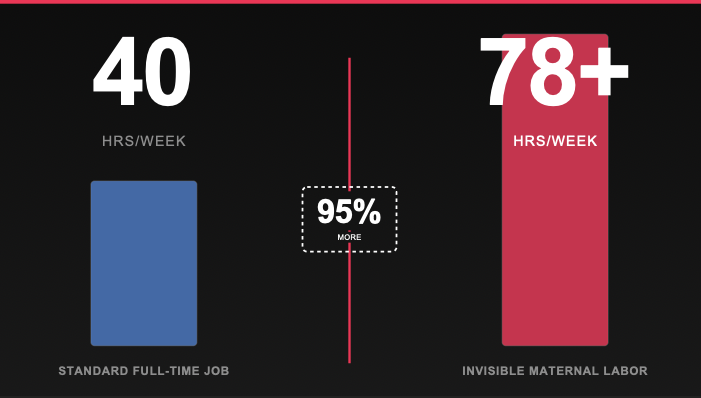
The spreadsheet turned my thoughts into raw data. And for the first time, I stopped arguing with myself about whether I should be doing better.
That created something unexpected: space.
Not a perfectly organized life. Not a magical solution. Just space. Space where shame used to live. And most importantly, a space where curiosity could start to replace self-blame.
This is where this series begins. This is where we – Invisible Mothers – begin. Not with productivity hacks. Not with better planners. But with something far more radical.
Honesty.
PART 5 – THE INVITATION – RADICAL HONESTY
Or, who are you when nobody sees you?
Before we talk about solutions, systems, or small steps forward, I want to invite you to try something simple.
Pause.
Just for a moment. (I know you have heard this one before.)
Put down the invisible list running through your head right now – the laundry, the errands, the emails, the dinner you still need to figure out. Just sixty seconds. Then ask yourself one question. Not the polite version. The honest one:
What am I currently pretending is easy – that is actually hard? Or even impossible?
Write it down. Don’t edit it. Don’t soften it. Just let the truth exist on the page.
Maybe it’s managing the emotional world of your entire household. Maybe it’s trying to parent like you have no job while working like you have no children. Maybe it’s holding everyone else together while quietly falling apart inside. Whatever it is, just witness it.
Because the first step out of exhaustion isn’t doing more. It’s finally seeing clearly what you’ve been carrying.
And if this is the first time you’re letting yourself acknowledge that weight, I want you to hear this:
You aren’t failing. You aren’t weak. You aren’t the only one standing in the kitchen wondering why everything keeps collapsing the moment you stop holding it together.
You are a human being doing work that has been invisible for far too long.
I see you.
And you’re not alone anymore.
Welcome to the honest, real middle – the place where the pretending ends and the real conversation begins.
This is Part 1 of the Invisible Mothers series, and the deeper you go, the clearer it gets.
Part 2 – The Invisible Labor Crisis: Why Moms Are Exhausted and It’s Not Their Fault The full data on invisible labor. What it actually costs and why the system depends on you not knowing.
Part 3 – Your Brain Under Chronic Stress: What Neuroscience Says About Mom Exhaustion What chronic stress actually does to the maternal brain. Why you snap at 8pm and why it’s not your fault.
Part 4 – What Are You Carrying That Isn’t Yours? The Inherited Patterns You Don’t See The patterns you didn’t choose. Neural pathways built in your childhood, way before you could question anything. And what changes when you finally see that.
Want to stay in touch? Get the next posts, tools, and insights straight to your inbox. I only write when I have something real to say.
FREQUENTLY ASKED QUESTIONS
Why does motherhood feel so impossible?
Because it is. Modern mothers are expected to work like they have no children and parent like they have no job, while the village that was supposed to share the load has been systematically dismantled. What feels like personal failure is actually a structural design flaw.
What is invisible labor in motherhood?
Invisible labor is all the work that keeps a household and family functioning that nobody sees, counts, or thanks you for. Mental load, emotional management, logistics, anticipatory planning.
Why do I feel like I'm failing at something natural?
Because somewhere along the way "natural" became code for "effortless." Motherhood is natural. It is not effortless. The expectation that it should be is a cultural lie that keeps mothers blaming themselves instead of questioning the system.
What is matrescence?
Matrescence is the neurological and psychological transition into motherhood comparable in scale to puberty. Your brain undergoes a significant remodel to make you more attuned to your children's needs. That attunement never fully switches off, which is part of why the cognitive load of motherhood is so relentless.
Why can't I stop thinking even when I'm exhausted?
Because your brain has been rewired to scan constantly for your children's needs and safety signals. This is matrescence in action. Combined with the cognitive overload of tracking dozens of micro-decisions simultaneously, the mental load doesn't stop when your body does.
2 responses to “You’re Doing the Impossible. Stop Pretending It’s Easy.”
[…] In Part 1, I show you how I stopped pretending motherhood was manageable. I admitted that the system itself is impossible – the cultural gaslighting, the impossible standards, the way society convinced us that this unsustainable thing is actually just “what mothers do.” Read more here. […]
[…] In Part 1, I named the impossible – admitted that the system itself is designed to break you. […]